
Possessive Nouns in English
Beginner to Elementary Grammar A1
In this article, Beginner to Elementary Grammar A1 learners study possessive nouns.
- Read more about Possessive Nouns in English
- Log in to post comments
Beginner to Elementary Grammar A1
In this article, Beginner to Elementary Grammar A1 learners study possessive nouns.
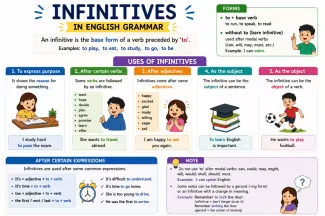
Elementary Grammar A2
In this article, Elementary Grammar A2 learners study infinitives.
You will learn how to plus base verb expresses purpose, plans, needs, and opinions.
The key question is: Does the sentence need to show purpose, intention, or a following action?
The main rule to remember is: Some verbs are followed by gerunds, some by infinitives, and some can take both with a change in meaning.
You will study infinitives after verbs, adjectives, nouns, and purpose phrases.
By the end, you should be able to use infinitives naturally after want, need, decide, easy, and important.
Verb patterns explain what form comes after a verb: gerund, infinitive, object plus infinitive, preposition plus gerund, or a clause.
Infinitives in English Grammar looks specifically at infinitives. At this level, the goal is to connect basic grammar with longer speaking and writing tasks.
As you read, keep one question in mind: Does the sentence need to show purpose, intention, or a following action? This question will help you connect the rule to meaning instead of memorizing the form alone.
You will see infinitives after verbs, adjectives, nouns, and purpose phrases, then practice the topic through corrections, short tasks, and a final review.
This section breaks infinitives into practical rules. Read each rule, study the examples, and notice how the form supports the meaning.
A gerund is a verb-ing form used like a noun.
An infinitive is to plus the base verb. It can show purpose, plan, desire, or result.
Some verbs can take both forms, but the meaning changes.
The examples below focus on infinitives. Read the sentence, then read the note so you can see why the grammar choice works.
| Use | Example | Why It Works |
|---|---|---|
| Core pattern | Swimming is healthy. | This example connects to infinitives and shows infinitives after verbs, adjectives, nouns, and purpose phrases. |
| Natural use | I enjoy reading. | This example connects to infinitives and shows infinitives after verbs, adjectives, nouns, and purpose phrases. |
| Meaning check | She is good at explaining ideas. | This example connects to infinitives and shows infinitives after verbs, adjectives, nouns, and purpose phrases. |
| Daily English | I want to learn. | This example connects to infinitives and shows infinitives after verbs, adjectives, nouns, and purpose phrases. |
| Careful writing | She came to help. | This example connects to infinitives and shows infinitives after verbs, adjectives, nouns, and purpose phrases. |
| Question form | It is easy to understand. | This example connects to infinitives and shows infinitives after verbs, adjectives, nouns, and purpose phrases. |
| Formal style | I stopped smoking means I quit. | This example connects to infinitives and shows infinitives after verbs, adjectives, nouns, and purpose phrases. |
| Review sentence | I stopped to smoke means I paused in order to smoke. | This example connects to infinitives and shows infinitives after verbs, adjectives, nouns, and purpose phrases. |
Infinitives becomes more useful when it appears inside connected writing, not only in isolated examples. Try using the topic in a short message, a description, a comparison, or an explanation.
A strong example should answer the article question: Does the sentence need to show purpose, intention, or a following action? If your sentence answers that question, the grammar is doing real work.
These mistakes show what can go wrong with infinitives. Compare the wrong sentence, the correction, and the reason before you write your own examples.
| Common Mistake | Correction | Why |
|---|---|---|
| This sentence use the grammar wrong. | This sentence uses the grammar correctly. | Check subject-verb agreement and word form. |
| I not understand the rule. | I do not understand the rule. | Use the correct auxiliary in negative sentences. |
| The meaning is not clear because word order. | The meaning is not clear because of the word order. | Check missing prepositions and connectors. |
Use these exercises after reading the article. They are designed around infinitives, so each task should help you use the topic in a specific way.
Write a short paragraph of five to seven sentences that includes infinitives. After writing, highlight the grammar pattern and explain how it answers this question: Does the sentence need to show purpose, intention, or a following action?
Answer these questions to check whether you can recognize and use infinitives without relying only on memory.
This topic is useful because it helps you make a specific grammar choice instead of relying on translation or habit.
Before you leave this article, check whether you can answer this question clearly: Does the sentence need to show purpose, intention, or a following action?
If the answer feels automatic, try using infinitives in a new sentence about your own life, work, studies, or opinions.
Next step: Write five sentences using infinitives for purpose or intention.