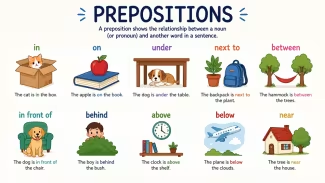
Prepositions are small but powerful words that help connect people, places, time, movement, and ideas in English sentences. Learning how to use prepositions correctly can greatly improve your speaking, writing, listening, and reading skills. This complete guide explains the most important types of English prepositions with simple rules and real-life examples. You will learn how to use prepositions for time, place, direction, relationships, possession, and common verb or adjective combinations. Each section is designed to make English easier to understand through clear explanations and practical sentences. By studying and practicing these patterns, you will become more confident and natural when communicating in English every day.
Prepositions of Time — In, On, At
Rules: Use "at" for precise times and holidays. Use "on" for specific days of the week and dates. Use "in" for longer periods like months, years, seasons, and parts of the day (except "at night").
Prepositions of Time — In, On, At Examples
- The meeting starts at 3:00 PM. (Precise clock time)
- We will gather at Christmas. (Holiday period)
- I have a doctor's appointment on Monday. (Day of the week)
- Her birthday is on October 15th. (Specific date)
- My family always travels in the summer. (Season)
- The company was founded in 2010. (Year)
- I prefer to drink coffee in the morning. (Part of the day)
Prepositions of Place — In, On, At
Rules: Use "at" for a specific point or general location. Use "on" for a surface or line (like roads). Use "in" for enclosed spaces, cities, or countries with boundaries.
Prepositions of Place — In, On, At Examples
- Someone is standing at the front door. (Specific point)
- She works at the hospital. (General location)
- The book is on the kitchen table. (Surface)
- The new restaurant is on Main Street. (Street/Line)
- The keys are in my pocket. (Enclosed space)
- They currently live in Tokyo. (City)
- There is a lot of wildlife in the forest. (Enclosed natural space)
Prepositions of Movement and Direction
Rules: These prepositions show movement from one place to another. "To" indicates a destination. "Into" shows entering an enclosed space. "Onto" shows movement to a surface. "Through" means moving across an interior space from one side to the other.
Prepositions of Movement and Direction Examples
- We are walking to the park. (Destination)
- She quickly jumped into the swimming pool. (Entering an enclosed space)
- The cat leaped onto the high shelf. (Moving onto a surface)
- The train traveled through the dark tunnel. (Moving interiorly from side to side)
- He walked toward the exit. (Movement in a specific direction)
- The kids ran across the busy street. (Moving from one side to the other)
- They hiked up the steep mountain. (Upward movement)
Prepositions of Spatial Relationship
Rules: These words describe where objects are in relation to one another. Use "above" or "over" for higher positions, "below" or "under" for lower positions, "between" for two items, and "among" for three or more items.
Prepositions of Spatial Relationship Examples
- The picture hangs above the fireplace. (Higher position, not touching)
- The dog is sleeping under the table. (Lower position, covered)
- She held the umbrella over her head. (Directly higher, covering)
- The temperature dropped below freezing. (Lower on a scale)
- I sat between my mother and my father. (In the middle of two people)
- The small cabin was hidden among the trees. (Surrounded by three or more things)
- The pharmacy is next to the grocery store. (Directly adjacent)
Prepositions of Agency and Instrument
Rules: "By" is used to show who or what caused an action, commonly in passive voice sentences, or to show a method of transportation. "With" is used to show the tool, instrument, or object used to complete an action.
Prepositions of Agency and Instrument Examples
- The novel was written by Charles Dickens. (Agency/Who did it)
- We prefer to travel by train. (Method of transportation)
- The window was broken by a baseball. (What caused the action)
- He cut the vegetables with a sharp knife. (Instrument used)
- She unlocked the door with her key. (Tool used)
- I usually eat soup with a spoon. (Instrument used)
- The painting was created with water-based colors. (Material used)
Prepositions of Origin and Source
Rules: Use "from" to indicate where someone or something originates, or the starting point of an action. Use "of" to describe what material something is made out of, especially when the material doesn't change form.
Prepositions of Origin and Source Examples
- My best friend is from Brazil. (Geographical origin)
- I received a beautiful letter from my grandmother. (Source of an object)
- Take the toy away from the baby. (Starting point of movement)
- This antique desk is made of solid oak. (Material source)
- She is a woman of great intelligence. (Originating quality)
- The fabric is woven from pure cotton. (Material origin)
- Water flows from the mountain spring. (Physical starting point)
Prepositions of Connection and Possession
Rules: Use "of" to express belonging or relating to something. Use "with" to express having or possessing a physical feature or object. Use "about" to indicate the subject matter of a conversation or text.
Prepositions of Connection and Possession Examples
- That is the car of the company president. (Belonging to)
- I need to read the first chapter of the book. (Part of a whole)
- The girl with the red hair is my sister. (Possessing a physical trait)
- I want a house with a large backyard. (Possessing a feature)
- We talked about our future plans. (Subject matter)
- This documentary is about marine biology. (Topic)
- He is a friend of mine. (Relationship connection)
Dependent Prepositions — Verbs
Rules: Many English verbs are followed by specific prepositions that must be memorized as a pair. There is often no logical rule; the verb simply requires that specific preposition to make sense.
Dependent Prepositions — Verbs Examples
- I completely agree with your proposal. (Agree + with a person/idea)
- She is waiting for the bus to arrive. (Wait + for)
- Please listen to the teacher carefully. (Listen + to)
- He apologized for his rude behavior. (Apologize + for an action)
- We rely on our parents for support. (Rely + on)
- You must concentrate on your studies. (Concentrate + on)
- I am looking forward to the weekend. (Look forward + to)
Dependent Prepositions — Adjectives
Rules: Similar to verbs, certain adjectives are naturally paired with specific prepositions to express feelings, abilities, or states of being. These also need to be memorized.
Dependent Prepositions — Adjectives Examples
- She is afraid of spiders. (Afraid + of)
- He is very good at playing the piano. (Good + at a skill)
- I am interested in learning history. (Interested + in)
- The city is famous for its architecture. (Famous + for)
- My opinion is different from yours. (Different + from)
- They are excited about the upcoming concert. (Excited + about)
- She is tired of hearing the same excuses. (Tired + of)