
Modal Verbs for Beginners
Elementary Grammar A2
In this article, Elementary Grammar A2 learners study modal verbs.
You will learn how to use modal verbs in clear English sentences.
- Read more about Modal Verbs for Beginners
- Log in to post comments
Elementary Grammar A2
In this article, Elementary Grammar A2 learners study modal verbs.
You will learn how to use modal verbs in clear English sentences.
Elementary Grammar A2
In this article, Elementary Grammar A2 learners study need and needn't.
You will learn how need works as a main verb and as a modal-like verb in negatives.
The key question is: Does need behave like a normal verb or a modal in this sentence?
Elementary Grammar A2
In this article, Elementary Grammar A2 learners study must and have to.
You will learn how must and have to express strong obligation, rules, and necessity.
The key question is: Is the obligation personal, official, external, or logical?
Elementary Grammar A2
In this article, Elementary Grammar A2 learners study gerunds vs infinitives.
You will learn how to choose between verb-ing and to plus base verb after another word.
Elementary Grammar A2
In this article, Elementary Grammar A2 learners study ought to.
You will learn how ought to gives advice, expectation, or moral recommendation.
The key question is: Is the speaker saying what is right, sensible, or expected?
Elementary Grammar A2
In this article, Elementary Grammar A2 learners study may and might.
You will learn how may and might express possibility and polite permission.
The key question is: How certain is the speaker, and is the sentence formal or neutral?
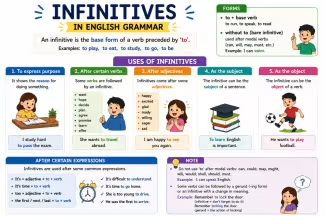
Elementary Grammar A2
In this article, Elementary Grammar A2 learners study infinitives.
You will learn how to plus base verb expresses purpose, plans, needs, and opinions.
The key question is: Does the sentence need to show purpose, intention, or a following action?
Elementary Grammar A2
In this article, Elementary Grammar A2 learners study will vs would.
You will learn how will and would differ in certainty, future meaning, politeness, habit, and imagined situations.
The key question is: Is the sentence real and future, polite, habitual in the past, or hypothetical?
Elementary Grammar A2
In this article, Elementary Grammar A2 learners study can and could.
You will learn how can and could express ability, possibility, permission, and polite requests.
The key question is: Does the sentence talk about ability now, ability in the past, possibility, or politeness?
Elementary Grammar A2
In this article, Elementary Grammar A2 learners study gerunds.
You will learn how verb-ing forms act like nouns in English sentences.
Suggested for you
Air brakes are an essential safety system used in heavy commercial vehicles across the transportation industry. These powerful braking systems rely on compressed air rather than hydraulic fluid to operate, making them particularly suitable for large vehicles that require substantial stopping power.